My Own Private Azeroth
2026-08-19 gamingwowmacosaiWhy I play the original WotLK offline on a personal AzerothCore server, and how I built a native macOS launcher that runs a 2010 Windows game at full speed on Apple Silicon — with AI doing the labour and human intuition doing the steering.
TL;DR — I play World of Warcraft 3.3.5a — the original Wrath of the Lich King — as a single-player RPG, on my own AzerothCore server with bots. To play it on a Mac I built wow-launcher: a fully self-contained wrapper that runs the 2010 client at ~120 FPS on Apple Silicon. The AI first told me the real ceiling was a quarter of that. It was wrong, and the story of how we got past that is the interesting part.
I like World of Warcraft. Specifically, I like Wrath of the Lich King — patch 3.3.5a, build 12340, the game as it was in 2010 — and I like playing it offline. That combination needs some explaining, because every part of it sounds wrong to somebody.
Offline, on purpose
I play WoW the way I'd play any offline RPG: at my own pace, no rush, no daily obligations, no communication for the sake of communication. The world of WotLK is big enough and dense enough to be a great single-player game — it just was never shipped as one.
The usual answer is "join a private server", and that's exactly what I don't want. Public pirate servers are full of questionable customizations, "seasonal" gimmicks, and sooner or later a cash shop — donate or lose. That's not the game I liked; that's somebody else's business model wearing its skin.
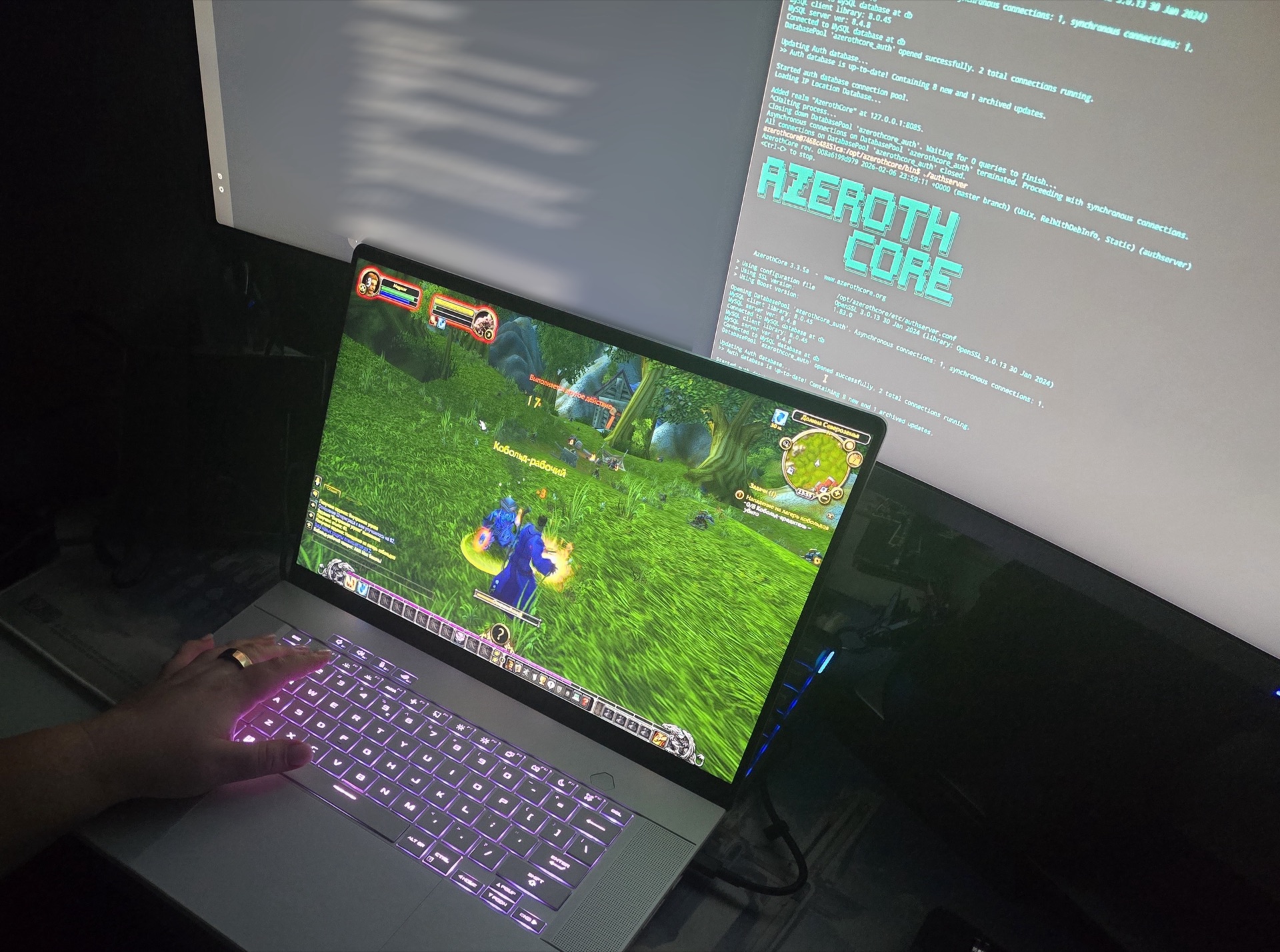
So I run a personal AzerothCore server with bots. My own realm, on my own
hardware, populated by AI-driven characters so the world doesn't feel empty. And I
do mean my own — here it is on a random night: the realm's authserver console up on
the big screen, Northshire on the laptop, the whole of Azeroth answering at
127.0.0.1.
And to be clear about the ethics: this is not piracy — I'm not even a lapsed customer. I still play on official servers; my main, Magazar of Ravencrest, is linked right on my about page. But I also bought World of Warcraft as it was back then, and I believe that gives me the right to keep playing the version I paid for — Blizzard just doesn't sell or host 3.3.5a anymore, so there is literally no legal storefront to give my money to. A personal server for a game I own, with no players and no profit, is preservation, not theft.
The Mac problem
There was one real obstacle: I play on a Mac. WotLK-era WoW is a 32-bit x86 Direct3D 9 Windows game — close to the worst possible match for an ARM Mac.
The existing options didn't fit:
- CrossOver works, but it isn't cheap — and I'd be paying a subscription-grade price to run exactly one game from 2010.
- WoWSilicon is a great project — it's actually the upstream that makes the performance possible — but it's a different shape of thing: a patcher/launcher that manages games living elsewhere on your disk and a shared wine prefix, with profiles for several expansions. I wanted a single-game appliance, not a system.
So I built my own: wow-launcher.
It assembles a fully self-contained WoW.app — the wine stack, the translation
layers, the prefix, everything baked into one bundle — with a native SwiftUI manager
in front. Nothing needs to be bought or installed first: one make downloads the
open-source wine runtime and the patch payloads from WoWSilicon's releases —
checksum-verified — and bakes everything into the bundle. Deleting the app removes
every trace. The result behaves like any other Mac
app: you start it and you play. On my M4 Max it holds ~120 FPS at native
Retina resolution — limited only by the screen's refresh rate.
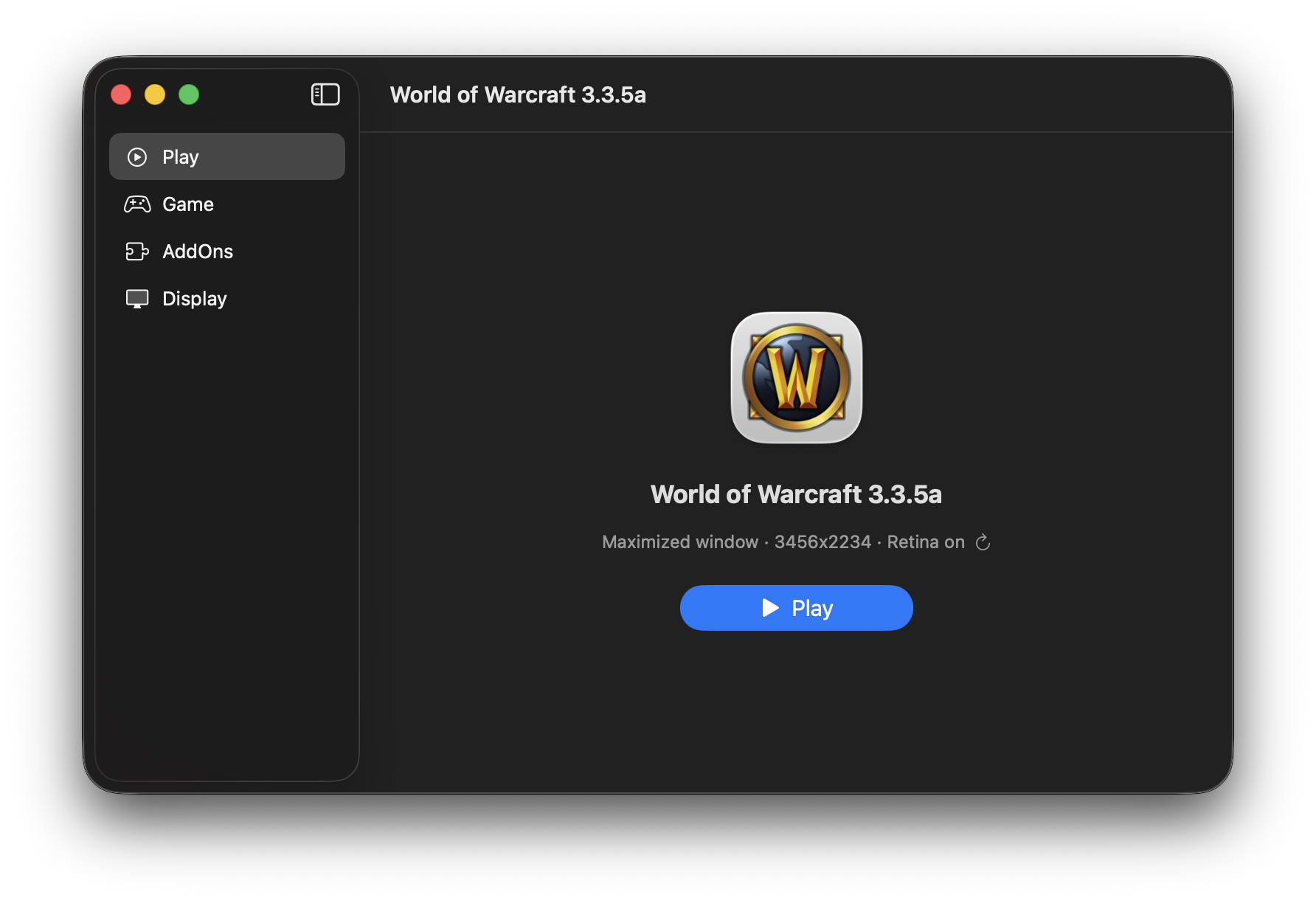
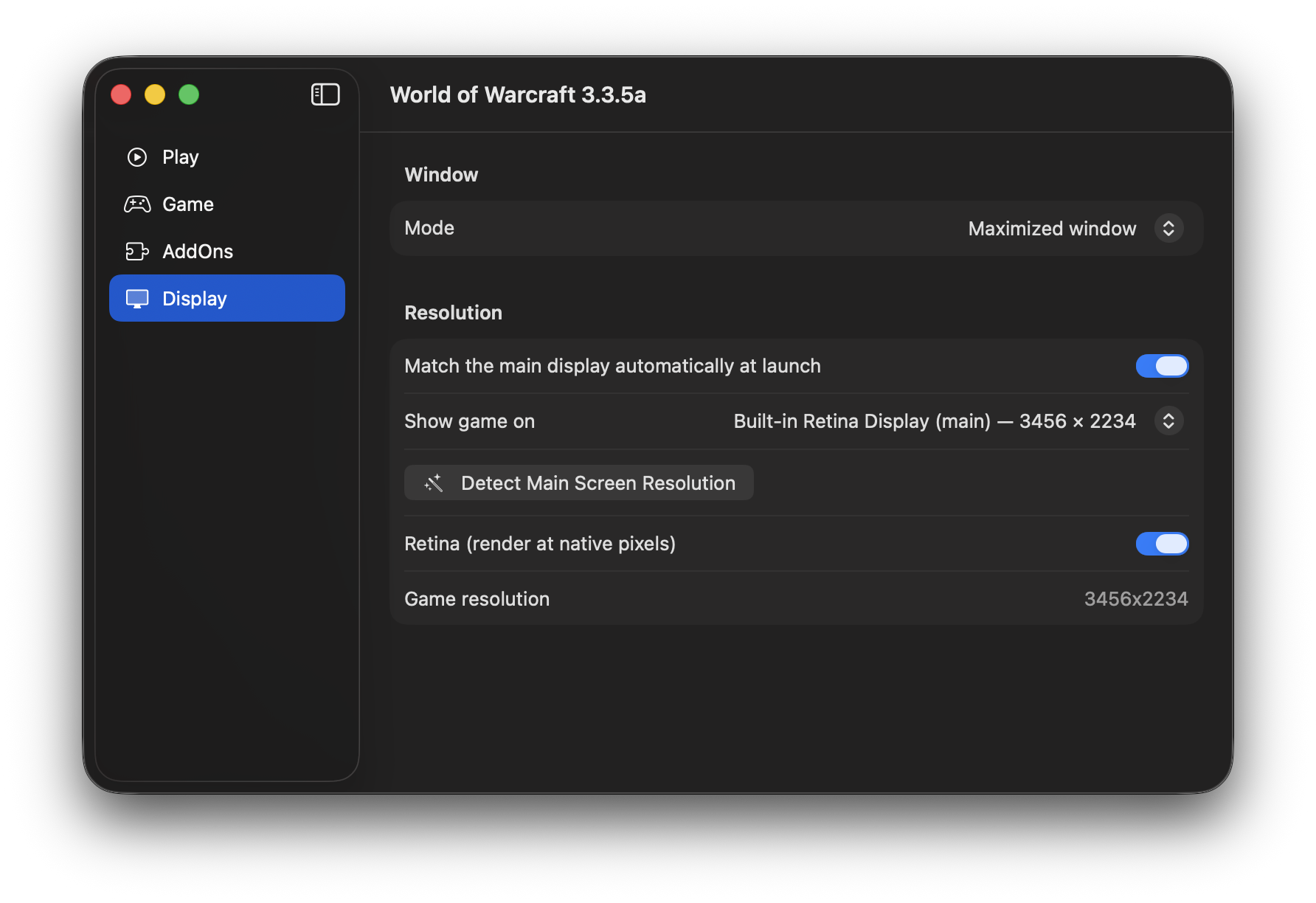
The manager installs and patches a client, verifies its integrity with one-click repair, manages addons and the server list, and handles window mode, resolution and Retina matching automatically — with a choice of renderer: DXVK by default, or the Metal-native MTLd3D with HDR output. No terminal needed — though everything the GUI does is also scriptable.
"There is no way" — and then there was
The part worth writing about is how it got built, because I did it with AI — two long Claude Code sessions — and the arc of those sessions says something about what AI can and cannot do.
Session one started with a crashing Wineskin wrapper and ended, after a lot of genuinely good work — a Warden crash fixed, a five-minute exit hang traced to dead Blizzard tracker endpoints, settings tuned — at a stable ~30 FPS. And then the AI delivered its honest verdict: this is the realistic ceiling; "Parallels + Windows 11 ARM remains the only path that would meaningfully change that." In other words: there is no way to do what you want.
I didn't accept that. Not because I knew better technically — because it felt wrong. An M4 Max crawling through a 2010 game isn't a hardware limit, it's a software problem, and software problems have authors.
Session two began as a graveyard of clever failures. DXVK builds that showed a black screen. A build that ran at one frame per second because of a deadlock between the game's async loader and the translation layer's deferred submissions. A celebrated "38 FPS milestone" that turned out to be a mirage — we'd most likely been measuring the old renderer the whole time. A full day of first-principles engineering that went nowhere.
Then I changed the strategy. Instead of asking the AI to invent the solution, I went looking for proof that one existed — and found it: WoWSilicon's stack ran the game flat-out on my machine — the very performance the AI had ruled out. The moment I saw it, the task transformed from research into engineering. I came back with a different instruction: stop inventing — this works; understand exactly why it works, then adopt it properly.
That reframing was everything. The AI took the working stack apart — CrossOver 26's wine, DXVK async for D3D9→Vulkan→Metal, winerosetta and rosettax87 for fast x87 math under Rosetta 2, libSiliconPatch client hooks — worked out what each piece did and why, and then rebuilt the whole thing as one self-contained app bundle that depends on none of the donor tools. Then, on top of it, a native SwiftUI manager: installer, integrity verifier with repair, addon manager, display logic, even Cyrillic chat input solved the way the community solved it years ago, with glyph-remapped fonts. Together we succeeded — and the whole thing took a few days. Before AI, this was weeks of work, most of it too tedious to ever actually do in the evenings.
But notice where each contribution came from. The AI supplied depth and speed:
tracing a deadlock to a specific polling loop in Wow.exe, patching a loader name in
a compiled ntdll.so so the Dock says "WoW", grinding through 41 verification
checks. What it could not supply was the refusal. Left alone, it reasoned its way to
"this is the ceiling, buy Parallels" — a defensible conclusion, honestly argued,
and wrong. The thing that got us past it was experience and, more importantly,
intuition: the itch that says a conclusion is wrong before you can prove it, and
the judgement to stop inventing and adopt what already works. That's the part only
the human brings. The AI will out-read you, out-type you, and out-patience you — but
it doesn't refuse to believe.
(Since then the wrapper has shed even the build-time donors: it now builds on WoWSilicon's open-source wine runtime, so CrossOver is out of the chain entirely.)
Northrend, smooth as ice
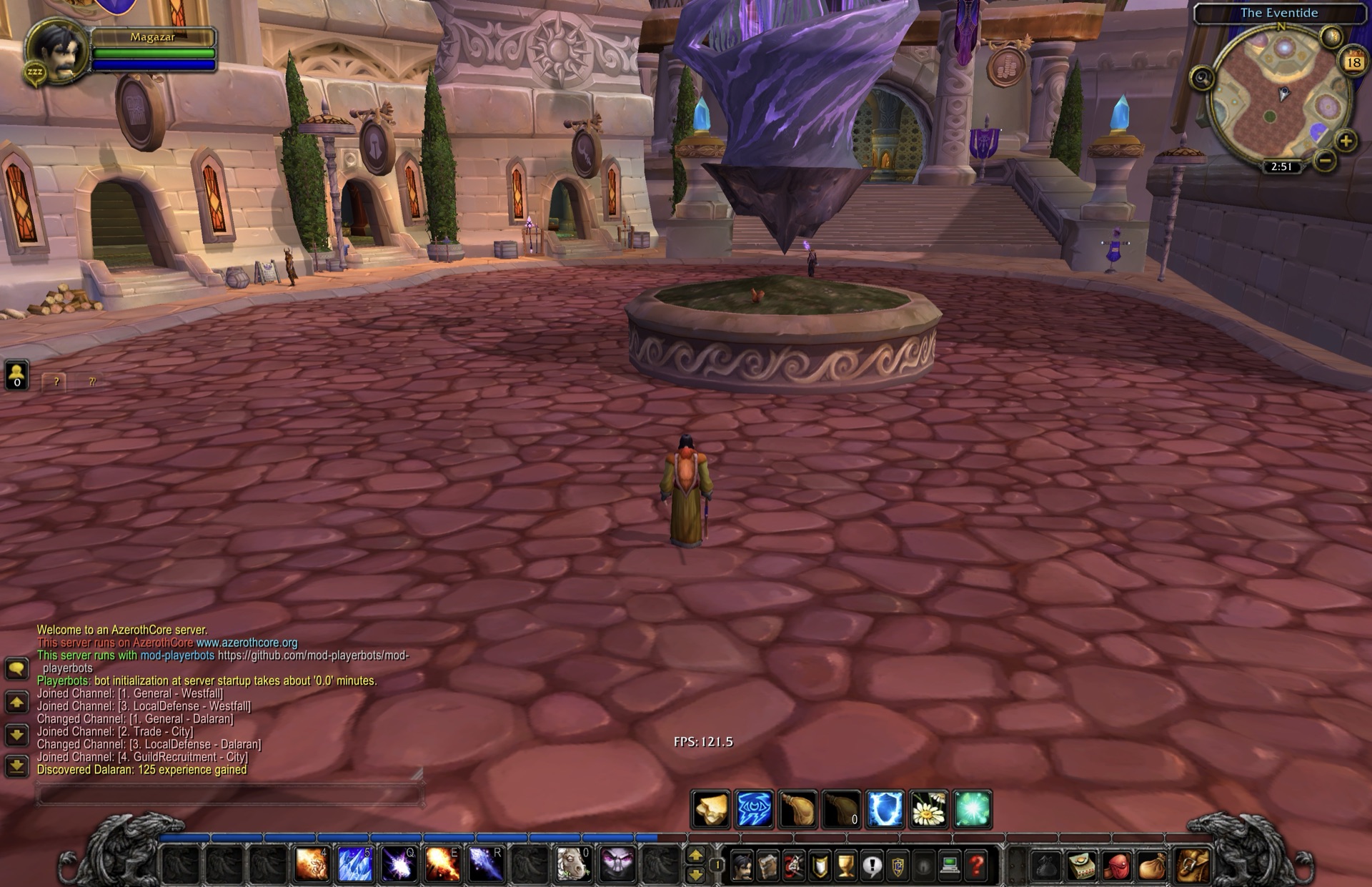
So now it just works. One icon in the Dock. Click, play, quest, log off whenever — no queue, no chat, no shop. The game I paid for, the way I remember it, running better on this machine than it ever ran on the hardware it was made for.
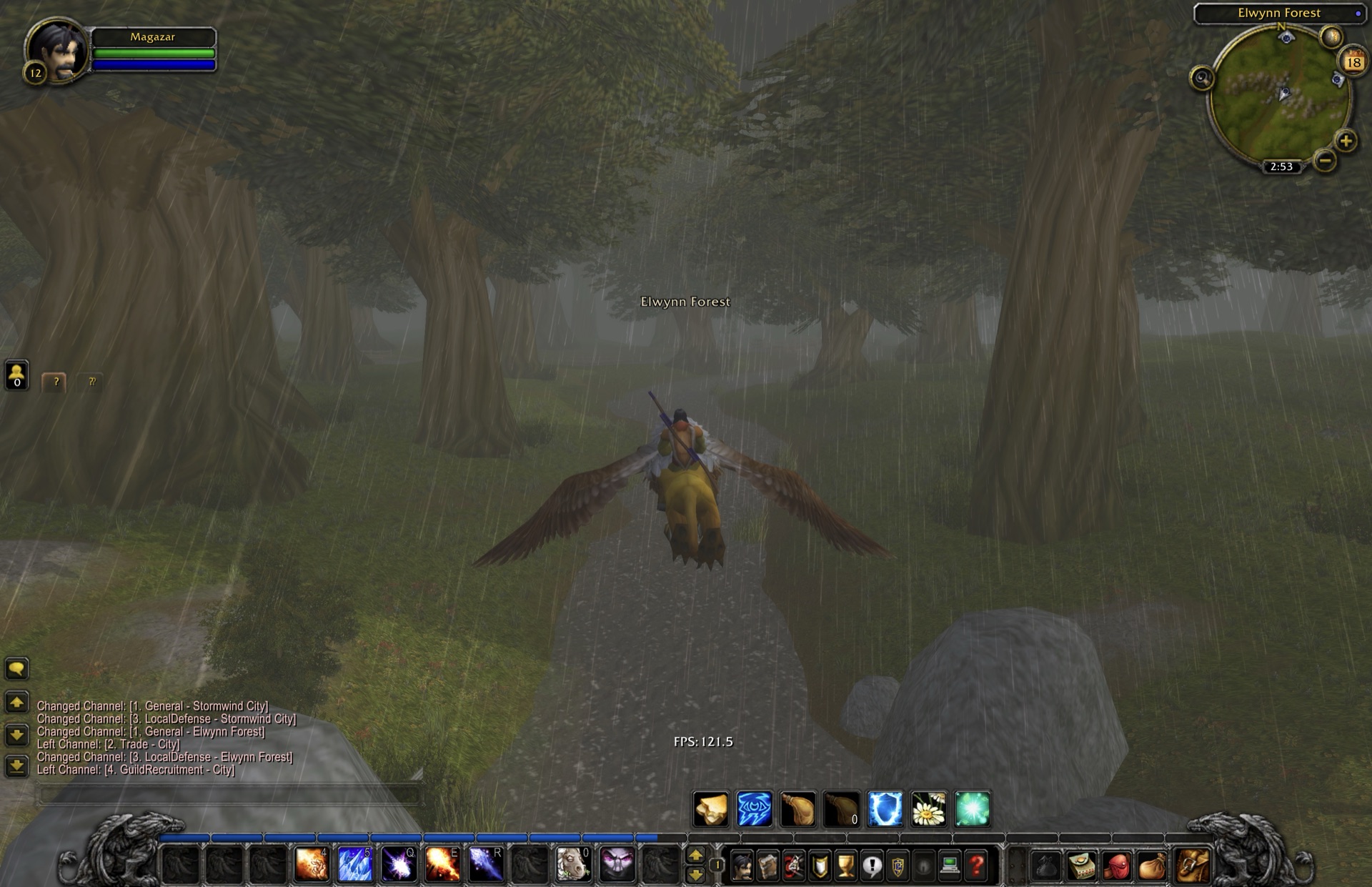
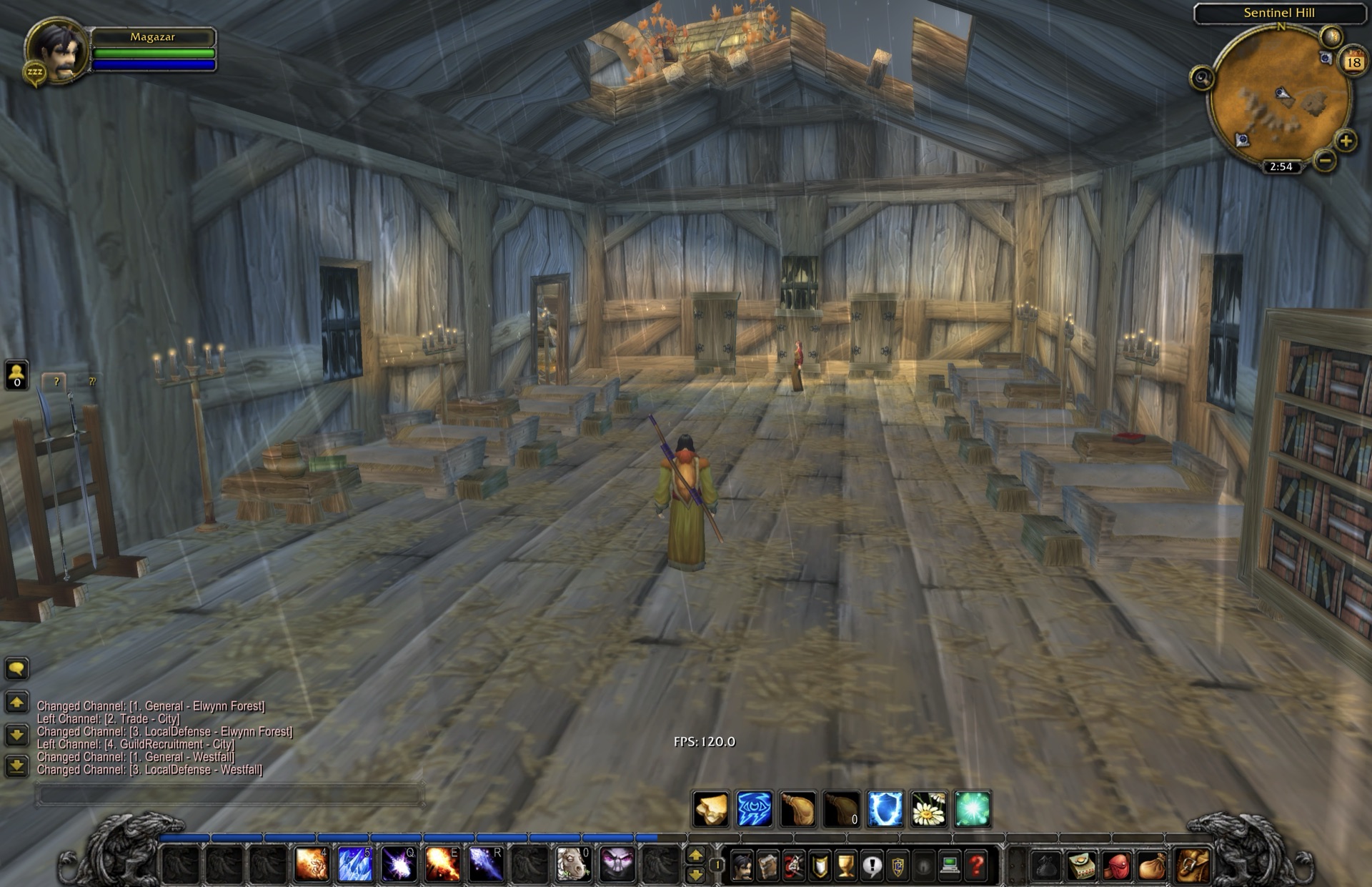
The launcher is open source under MIT — it ships no game data and is built around the original 3.3.5a client. If you have a Mac, an old love for Northrend, and your own copy of the game, everything you need is in the repo.